
ReimeiTech
REIMEITECH.
← SaaS & Product
Service · Billing Systems
Billing Systems

Usage-based, hybrid,or seat-based —all of it correctly.

ReimeiTech builds billing logic that handles metered usage, included quotas, overages, prorated upgrades, and credit notes — with idempotent metering and daily reconciliation against your accounting system.

// where money moves, "approximately right" is wrong. We build billing that ties out — to the cent.

Metered usageSeat-basedTiered & overageProrationInvoicingDunningTaxGL reconciliation
Scroll the ledger
§02Definition

A billing system is the logic between usage and the bank.

Your payment provider moves money. Your billing system decides how much, for what, and why — turning raw activity into priced line items, accurate invoices, successful charges, and numbers your finance team can close the books on.

It's metering, rating, invoicing, payments, dunning, tax, and reconciliation — built so every charge is provable and every dollar is accounted for.

Billing logic
usage → rating → invoice → cash
What you'll outgrow

Spreadsheet + provider defaults

  • Usage counted by hand or by guess
  • Pricing logic scattered across code
  • Proration done 'close enough'
  • Invoices that customers dispute
  • Provider numbers nobody reconciles
  • Month-end is an archaeology dig
What we build

A real billing system

  • Idempotent, auditable usage ledger
  • One rating engine for every model
  • Deterministic, previewable proration
  • Invoices that trace to the event
  • Daily provider-to-GL reconciliation
  • Books that tie out every day
§03Failure modes

Where billing quietly loses money.

Billing bugs don't crash — they leak. A fraction of a cent here, a dropped event there, a reconciliation that never runs. We build the system so the leaks are closed and provable.
Revenue leakage

$ git blame invoice.py → "who decided overage rounds down?" // nobody knows. that's the problem.

Moving from flat plans to usage-based
Customers dispute usage you can't explain
Finance can't tie the provider to the books
Proration math is inconsistent
Revenue leaks through untracked overages
Webhooks double-charge on retry
Credit notes are handled by hand
Failed payments quietly churn customers
Tax is a quarterly fire drill
Pricing changes require re-plumbing billing
§04Pricing models

Every pricing model, composed onto one invoice.

Real products rarely pick one model. We build a rating engine that composes subscriptions, seats, usage, tiers, and credits cleanly — so you can change pricing without rebuilding billing.

Flat Subscription
$/month

Flat Subscription

Fixed recurring price per plan, monthly or annual, with trials and renewals.

Per-Seat
$/seat

Per-Seat

Charge by active members or licenses, with mid-cycle seat changes prorated.
Usage / Metered
$/unit

Usage / Metered

Bill measured consumption — API calls, compute, tokens, GB — from an event ledger.

Tiered
$/tier

Tiered

Different unit prices per tier as usage crosses thresholds within a period.
Volume
bulk $

Volume

A single price-per-unit chosen by the total volume reached — bulk discounts done right.

Hybrid
base + usage

Hybrid

A base subscription plus seats plus metered overage — composed onto one invoice.
Prepaid Credits
wallet

Prepaid Credits

Customers buy credits up front; usage draws down a balance with top-ups and expiry.
Freemium + Overage
free → paid

Freemium + Overage

A free included quota, then metered overage — the modern PLG monetization curve.

§05Capabilities

The full billing ledger of capabilities.

24 building blocks across four columns. We ship the subset your pricing needs today — built so the rest slots in without a rewrite.

Catalog & plans
  • Products & plans
  • Subscriptions
  • Free trials
  • Coupons & discounts
  • Multi-currency
  • Price versioning
Metering & rating
  • Usage metering
  • Included quotas
  • Overage rating
  • Tiered & volume
  • Proration
  • Credits & wallets
Invoicing & money
  • Invoices
  • Invoice preview
  • Credit notes
  • Payment methods
  • Card retries & dunning
  • Tax calculation
Trust & finance
  • Webhooks
  • Revenue reports
  • Audit trail
  • Idempotent ops
  • GL reconciliation
  • Dispute workflow
§06Architecture

The pipeline from event to general ledger.

Every charge travels the same path: a metered event is rated against your pricing, rendered into an invoice, charged through the provider, then reconciled back against the books — idempotently, every step.

Billing pipeline

events ▸ meter ▸ rate ▸ invoice ▸ charge ▸ reconcile ▸ ledger // one path, idempotent end to end

01
Events
  • SDK / API
  • Webhooks
  • Imports
02
Meter
  • Idempotent
  • Dedupe
  • Aggregate
03
Rate
  • Plans
  • Tiers / quota
  • Overage
04
Invoice
  • Line items
  • Tax
  • Credits
05
Charge
  • Provider
  • Retries
  • Dunning
06
Reconcile
  • Provider ↔ GL
  • Daily diff
  • Breaks
07
Ledger / GL
  • QuickBooks
  • NetSuite
  • Xero
§07Metering

Count every billable event exactly once.

Metering is the foundation usage-based billing stands on. If an event is dropped you under-charge; if it's counted twice you over-charge and lose trust. We build an idempotent pipeline where every unit is recorded once and traceable forever.
Usage metering
meter.ingest()
{ event: "api.call",
qty: 1, key: "req_8fa2…",
ts: 1718e9 } ✓ counted
Idempotency keys on every event
Deduplication & replay-safety
Aggregation (sum, max, unique, last)
Time-windowed counters
Append-only usage ledger
Filters & dimensions per customer
Backfill & late-event handling
Tamper-evident audit trail
§08Quotas & overages

Included quotas, then overage that adds up correctly.

Give each plan an included allowance, then rate everything beyond it through clean tiers. We make the boundary math exact — no off-by-one at the quota edge, no surprise true-ups.
Quotas and overage

included: 1,000,000 calls used: 3,412,908 → overage: 2,412,908 rated across 3 tiers

rate card · api callsper period
0 – 1,000,000includedin the Pro plan
1M – 5M$0.00015 / calloverage tier 1
5M – 20M$0.00010 / calloverage tier 2
20M+$0.00006 / calloverage tier 3
Hard caps & soft limits
Per-plan included quotas
Tiered & graduated overage
Volume (bulk) overage
Unlimited with fair-use guards
Usage threshold alerts
§09Proration

Mid-cycle plan changes, computed to the day.

When a customer upgrades on day 12 of a 30-day cycle, the unused portion of their old plan is credited and the new plan is charged for the remainder. We compute it deterministically and preview it before charging.

Proration
upgrade · day 12 / 30

Starter → Pro, mid-cycle. No surprise invoice.

Proration · preview
Credit — unused Starter (18 / 30 days)−$29.40
Charge — Pro for remaining 18 days$119.40
Today's prorated total$90.00
Next renewal$199.00 / mo

// downgrade policy is configurable: apply now, or defer to period end.

§10Invoicing

Invoices customers trust — and can verify.

Every line item traces back to the exact events that produced it. When a customer asks "what is this charge?", you show them the receipt — not an apology.

Invoice
#INV-2026-04812 · Apr 2026
Amount due
$964.80
Pro plan · base (1 × $499.00)$499.00
Seats · members (14 × $12.00)$168.00
API calls · metered (2.41M)$362.40
Storage overage (120 GB)$9.60
Proration credit−$74.20
Tax (consumption, 0%)$0.00
Total$964.80
every line reconciles to its source events
Invoice
Itemized invoices
Invoice preview before charge
Credit notes & refunds
Custom branding & PDF
Tax lines & exemptions
Multi-currency
Net terms & due dates
Line items trace to events
§11Payments & dunning

Collect what's owed — without churning good customers.

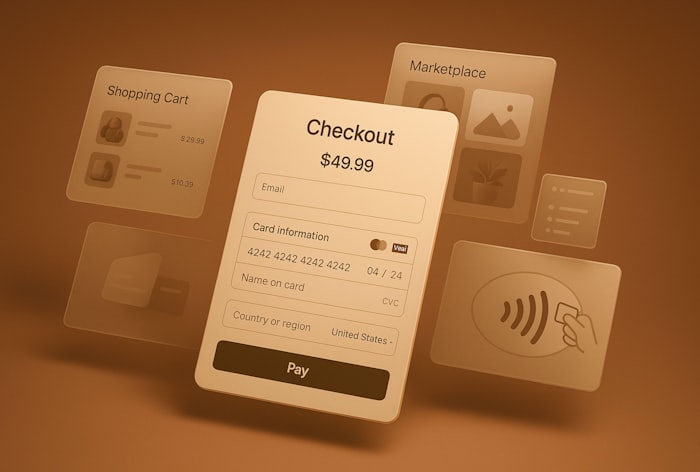
Payments and dunning

failed payment ≠ lost customer. recover ~70% of involuntary churn with smart retries + card-update prompts.

Payment methods
Cards
ACH / bank debit
Wallets (Apple/Google Pay)
SEPA
Wire / invoice net terms
Saved payment methods
Dunning sequence
Day 0Charge fails · soft-decline detected
Day 1Smart retry + card-update email
Day 3Second retry · dunning notice
Day 5Final retry · grace period warning
Day 7Downgrade / pause per policy
§12Tax & compliance

Tax as a correct line item — not a quarterly panic.

We integrate tax engines to compute the right rate by jurisdiction, apply it to invoices, handle exemptions and reverse-charge, and keep filing-ready records — so tax is calculated once, correctly, at the point of sale.
Tax compliance
rate resolved at checkout · recorded for filing
Jurisdiction-based rates
VAT / GST / sales tax
Consumption tax (JCT)
Reverse-charge handling
Exemption certificates
Tax lines on invoices
Filing-ready records
Stripe Tax / Avalara
§13Revenue & reporting

The numbers leadership sees — the same ones finance closes on.

Revenue reporting

MRR · ARR · NRR · churn · deferred revenue — derived from the ledger, not estimated in a slide.

MRR
$248,120
+6.2%
ARR
$2.98M
+18%
Net revenue retention
114%
+3pt
Gross churn
1.8%
−0.4pt
Expansion MRR
$31,400
+9%
Deferred revenue
$612k
Avg. revenue / account
$1,840
+4%
Failed-payment recovery
71%
+5pt
§14Reconciliation

Tie the provider to the books — every single day.

This is the line in the catalog that finance actually cares about. Each day we diff what the provider reports against what your accounting system recorded, and surface every break as a line item — so month-end becomes a formality, not an investigation.

daily reconciliation · 2026-04-30 provider ↔ GL
ItemProviderLedger (GL)Status
Card charges$248,120.00$248,120.00match
Refunds−$3,410.00−$3,410.00match
Processing fees−$7,184.48−$7,184.48match
Payouts$237,525.52$237,525.52match
Disputed (in review)−$240.00$0.00break
Reconciliation
1 break · auto-flagged

The disputed charge is the only difference — explained, tracked, and cleared when the dispute resolves. Nothing else to chase.

§15Disputes & chargebacks

Fight chargebacks with the evidence already on file.

Because every charge traces to its events, dispute evidence assembles itself. We build the workflow to respond fast, track outcomes, and feed the result straight back into reconciliation.

Disputes

dispute → evidence (auto-assembled from the usage ledger) → response → outcome → books updated
01
Dispute opened
02
Evidence assembled
03
Response submitted
04
Bank decision
05
Ledger updated
InquiryNeeds responseEvidence submittedWonLostRefunded
§16Integrations

The rails, the books, and everything between.

Integrations

stripe / orb ↔ rating ↔ quickbooks / netsuite / xero // billing only counts if it reaches the GL

Billing rails
Stripe BillingOrbMetronomeLagoChargebeeRecurlyPaddle
Accounting / GL
QuickBooksNetSuiteXeroSageCustom GL export
Tax
Stripe TaxAvalaraAnrokTaxJar
Data & ops
SnowflakeBigQuerySegmentSlack alertsWebhooks
§17Correctness & trust

Built like money depends on it. Because it does.

Billing is the one system where "mostly works" is a liability. We engineer for correctness first — idempotency, determinism, and auditability are not features here, they are the foundation.
Correctness

assert(invoice == replay(events)) // if it doesn't reproduce, it doesn't ship

Idempotent operations

Every billing action carries a key — retries and replays never double-charge or double-count.

Deterministic rating

The same usage and pricing always produce the same invoice — no floating-point surprises.

Append-only audit log

Nothing is silently edited; every change to money is recorded and traceable.

Shadow billing

Run the new system in parallel and prove the numbers match before any customer is charged.

Test clocks

Simulate renewals, trials, and dunning across time to catch edge cases before production.

Replayable events

Re-derive any invoice from source events — the ultimate dispute and audit defense.

§18Deliverables

What you receive.

Deliverables

a billing system that ties out — with the runbook finance and support actually need.
01Billing-model & pricing review
02Metering pipeline with idempotency
03Rating engine (tiers / quota / overage)
04Proration & plan-change logic
05Subscription & plan catalog
06Invoice generation & preview
07Credit notes & refunds
08Payment-method handling
09Card retries & dunning
10Tax engine integration
11Stripe Billing or Orb integration
12Accounting / GL integration
13Daily reconciliation to GL
14Dispute & chargeback workflow
15Revenue reports (MRR / ARR / churn)
16Audit trail & idempotency
17Shadow billing & test clocks
18Migration from existing billing
19Testing & QA
20Documentation
21Runbook for finance & support
22Post-launch tuning
§19Technology

Technology we use.

Technology

the right rail for your model — Stripe for breadth, Orb / Metronome for heavy metered usage.
Billing rails
Stripe BillingOrbMetronomeLago
Backend
PythonFastAPINode.jsTypeScript
Data
PostgreSQLKafka / queuesClickHouseRedis
Workflows
TemporalIdempotency keysTest clocksCron / schedulers
Accounting
QuickBooksNetSuiteXeroGL exports
Tax
Stripe TaxAvalaraAnrok
Reporting
SnowflakeBigQuerydbtMetabase
Cloud
AWSVercelDockerCI/CD
Correctness
IdempotencyAudit logsShadow billingReplay tests
§20Demo

Example: usage → invoice → reconciled.

Demo
Recommended demo

A usage-based invoice, end to end.

events ▸ meter ▸ rate ▸ invoice ▸ charge ▸ reconcile ▸ report — with every line provable.
01
Usage events stream in
02
Metered idempotently
03
Rated against the plan
04
Invoice previewed
05
Charged via provider
06
Reconciled to the GL
07
Revenue reports update
08
Books tie out daily
§21Industries

Who billing systems are for.

SaaS platforms

SaaS platforms

Subscriptions, seats, trials, and expansion revenue billed cleanly across plans.

Infra & API companies

Infra & API companies

High-volume metered usage — compute, requests, bandwidth — rated to the unit.

AI products

AI products

Token and inference billing with included quotas, overage tiers, and prepaid credits.
FinTech

FinTech

Transaction fees, interchange, and financial-grade reconciliation and audit.

Marketplaces

Marketplaces

Take-rates, payouts, and split billing across many buyers and sellers.

Agencies & services

Agencies & services

Retainers, milestones, and usage add-ons invoiced and reconciled per client.

§22Process

How we build billing systems.

Billing-Model Discovery
Step 01

Billing-Model Discovery

We map your pricing, plans, usage events, quotas, and exactly how revenue should be recognized.
Metering & Rating Design
Step 02

Metering & Rating Design

We design the idempotent event pipeline and the rating engine for seats, tiers, quotas, and overage.
Invoice, Tax & GL Design
Step 03

Invoice, Tax & GL Design

We define invoices, credit notes, tax handling, and how every charge maps to the general ledger.
Development
Step 04

Development

We build metering, rating, invoicing, payments, dunning, integrations, and reconciliation.
Shadow Billing & QA
Step 05

Shadow Billing & QA

We run the system in parallel with test clocks and replay tests until the numbers match to the cent.
Migration & Cutover
Step 06

Migration & Cutover

We migrate subscriptions and usage, then cut over with no double-charges and no lapsed accounts.
Reconciliation & Close
Step 07

Reconciliation & Close

We turn on daily reconciliation and tune dunning and reporting against real revenue.
§23Scope

What a billing system is not.

What this is not

the goal: a provable, reconciled billing system — every charge traceable, every dollar accounted for.

Just a Stripe Checkout button
A pricing page
Approximate, best-effort metering
Reconciliation done in a spreadsheet
Trusting the provider's totals blindly
§24FAQ

Questions, answered straight.

Stripe is the rails, not the system. It moves money and stores subscriptions — but it doesn't know your quotas, your overage rules, your proration policy, your usage-to-line-item mapping, or how to tie a payout to a journal entry in your accounting software. We build the billing logic on top of Stripe (or Orb / Metronome) so the rails are driven correctly and the numbers reconcile.
Build your billing system · §26

Bill it correctly.
Reconcile it daily.

Tell us how you price — flat, per-seat, metered, tiered, or all of the above — and where billing hurts today. We'll build the metering, rating, invoicing, dunning, and reconciliation so every charge is provable and every dollar is accounted for.

// ReimeiTech builds billing systems — metered usage, included quotas, overages, proration, invoicing, dunning, tax, and daily GL reconciliation — usage-based, hybrid, or seat-based, all of it correctly.